
Industrial Laundry Service: A Guide for Local Businesses
An industrial laundry service can take a recurring operational task off a local business’s plate, but the real comparison is broader than washing clothes. This guide is for operators who must coordinate several textile categories, sustained demand, or a workflow that cannot rely on spare staff time. Restaurants, hotels, gyms, healthcare organizations, and Airbnb operators may manage towels, linens, uniforms, and other textiles. Staff may also be assigned to sort, wash, dry, fold, and store them.
Explore commercial laundry service for your business
An industrial laundry service is a business-to-business solution for processing recurring operational textiles at a commercial scale. For a local business, the right option can reduce in-house workload by shifting washing, drying, folding, storage coordination, and routine handling into a planned service relationship. It is distinct from residential wash-and-fold, which is designed for household laundry rather than ongoing business operations.
The best choice depends on what your team handles today, how volume changes, and which parts of the workflow create the most friction. Start by defining what the service includes and how it fits a local business’s day-to-day operation.
What Is an Industrial Laundry Service for a Local Business?
An industrial laundry service is a business-scale textile cleaning program for organizations that handle recurring laundry as part of daily operations. The work may include towels, linens, uniforms, and other operational textiles. Instead of treating each load as a one-time household chore, the service organizes repeat processing around the business’s inventory, workflow, and service needs.
This article is not a general introduction to every business laundry option. It is a screening guide for operations with sustained volume, multiple textile categories, or a need to coordinate repeat processing across departments, shifts, rooms, or service areas. A smaller business with occasional loads may need a different conversation.
For a local restaurant, hotel, gym, healthcare organization, Airbnb operator, or similar business, laundry can affect much more than cleanliness. Soiled textiles must be collected, sorted, washed, dried, folded, stored, and returned to the right place before staff need them again. A dependable commercial program takes that recurring requirement into account and helps the business plan laundry as an operating function rather than an interruption.
Explore commercial laundry service for your business.
How is commercial laundry different from residential wash-and-fold?
Residential wash-and-fold is designed around an individual’s or household’s personal clothing, towels, and bedding. A customer brings in or schedules laundry for a personal order, and the service is organized around that order. It is a distinct offering from commercial laundry.
Commercial laundry is a recurring B2B service line. The textiles belong to, support, or represent a business, and the process must fit an ongoing routine. That can mean separating items by type or use, tracking repeat volumes, coordinating account contacts, and planning when clean textiles need to be available. The goal is not simply to finish a single bag. It is to support a repeatable supply of usable business textiles.
This distinction matters when comparing options. A small business managing laundry in-house must account for washing, drying, folding, storage, equipment demands, and staff time. Those responsibilities compete with customer service, food preparation, room turnover, appointments, or other revenue-producing work. Outsourcing may make operational sense when the recurring workload is difficult to absorb without disrupting the team.
Why do recurring business textiles change the workflow?
Recurring textiles create a predictable cycle. Items leave the business after use, enter a handling and cleaning process, and need to return ready for the next operating cycle. The business therefore needs clear expectations around what is being processed, how volume changes, and how clean items are organized when they come back.
An industrial laundry service does not eliminate the need for good handling at the business. Staff still need to identify items, follow any special instructions, and keep soiled and clean textiles organized. It does, however, create a framework for managing the repeated work through a commercial account instead of assigning every load to whoever has time that day. That structure is the practical difference between occasional full-service laundry and a laundry program built for a local business.
Which Businesses and Items Fit an Industrial Laundry Service Qualification?
The best fit is a business with a steady stream of reusable textiles that must be cleaned, dried, folded, stored, and returned on a dependable routine. This qualification angle is narrower than a general business-laundry overview. It asks whether the operation has enough recurring complexity to require documented categories, volume planning, handoff controls, and account ownership. That can include a hotel turning over room linens, a restaurant managing table service, or a fitness facility cycling through towels. Top Spin Laundry identifies restaurants, hotels, gyms, healthcare organizations, and Airbnb operators as businesses with recurring laundry needs. Commercial laundry service is the appropriate B2B conversation, rather than assuming a residential wash-and-fold process is designed for business operations.
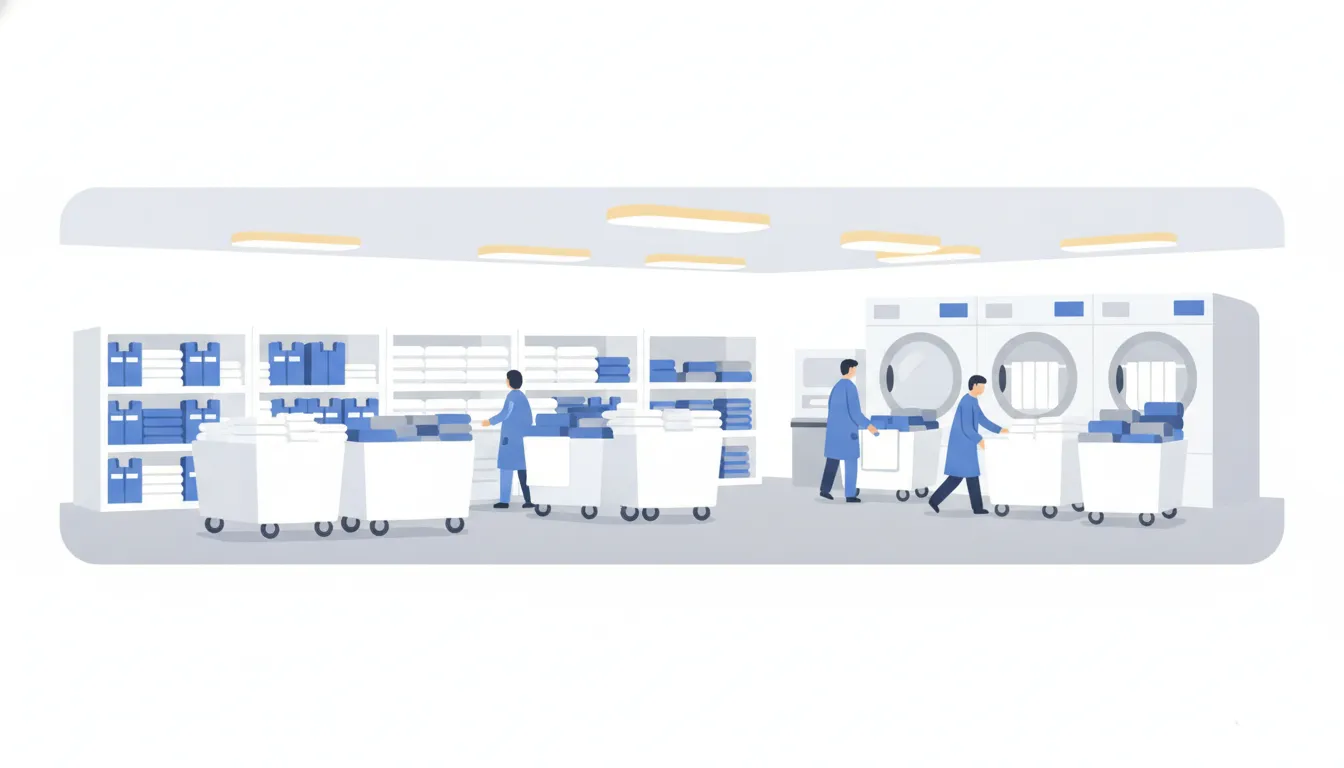
Lodging, food service, and rental properties
Hotels, motels, vacation rentals, and Airbnb operators commonly handle sheets, pillowcases, duvet covers, towels, robes, and bath mats. These items move through rooms and guests repeatedly, so the challenge is not a single large wash. It is maintaining enough clean inventory while dirty items are collected, processed, and put back into use. For lodging operators, hotel linen and towel care is a useful way to think about the operational requirements.
Restaurants and catering businesses may need table linens, linen napkins, bar mops, towels, aprons, and chef coats. The same principle applies to uniforms: recurring cleaning can support a business that needs staff apparel ready for the next shift. See the service options for restaurant linen cleaning when food-service textiles are a meaningful part of your workload.
Gyms, salons, and personal-service businesses
Gyms and fitness facilities often cycle through gym towels, while salons and spas may use salon linens, towels, robes, and cleaning cloths. Mats, microfiber cloths, and cleaning rags may also be part of a recurring textile program. Separate these categories when discussing an account so the provider can understand soil levels, color requirements, folding preferences, and how each item returns to service.
Healthcare textiles require a separate check
Healthcare organizations may handle sheets, blankets, towels, patient clothing, uniforms, scrubs, gowns, and surgical drapes, according to the CDC’s healthcare laundry guidance. That does not mean every commercial provider accepts every healthcare textile. Ask specifically about the items, contamination risks, handling procedures, equipment, and compliance requirements before sending anything. CDC guidance applies to healthcare laundry performed in-house or through a contract service, and emphasizes proper handling, hygienic processing, and separation of soiled and clean storage.
Before requesting service, make an inventory by item type and note approximate weekly volume, soil condition, and handling concerns. A clear list helps determine whether a provider can safely and consistently process the textiles your business actually uses.
How Does Outsourcing Compare With In-House Laundry Work at Sustained Volume?
For a business handling recurring towels, linens, uniforms, or other operational textiles, the choice is not simply who runs the washing machine. This comparison is most useful when volume is sustained and the operation has multiple categories, departments, shifts, rooms, or service areas to coordinate. In-house laundry assigns the full workflow to your team, from sorting and washing through drying, folding, storage, and distribution. An outsourced industrial laundry service transfers much of that recurring workload to a commercial operation, while your team concentrates on using the clean items and serving customers.
| Consideration | In-house handling | Outsourced commercial laundry |
|---|---|---|
| Labor time | Employees must sort, load, transfer, dry, fold, store, and retrieve laundry. Those duties compete with front-of-house, housekeeping, food service, or administrative work. | Your team still needs a clear handoff and inventory routine, but the repeated washing, drying, and folding workload moves outside the business. |
| Equipment and maintenance | The business supplies suitable washers and dryers, manages capacity, and maintains equipment according to the manufacturer’s instructions. | The provider manages its processing equipment and maintenance program. Confirm how it handles specialized textiles and unusual loads before opening an account. |
| Detergent and utilities | Water, electricity or gas, detergent, and related supplies become operating inputs that rise with volume. Labor, equipment maintenance, and detergent are also recognized in commercial industry comparisons as in-house cost categories, without implying a guaranteed savings amount. | These processing inputs are incorporated into the provider’s service arrangement. Ask what is included and how specialty cleaning requirements are handled. |
| Storage | The business needs room for clean inventory, soiled items awaiting processing, and movement between the two. Space planning becomes more important as volume grows. | Less on-site processing space may be needed, but the receiving area still needs an organized handoff and a protected place for clean items. |
| Process control | You control sorting, timing, products, and who handles each load. That can be useful when requirements are simple and staff capacity is dependable. | You gain a defined external process, but control depends on agreed handling instructions, communication, and quality checks. CDC guidance notes that laundering outcomes depend on time and temperature, mechanical action, water quality, load volume, soil level, and equipment. |
| Consistency | Results can vary when different employees sort loads, use different settings, or work under time pressure. | A recurring account can be organized around consistent processing and documented preferences. Review how the provider identifies, sorts, and returns your items. |
| Operational focus | Laundry remains an internal production task, even when it is not a core revenue activity. | Your staff can spend more attention on guests, diners, patients, members, or residents while the laundry workflow follows an external service routine. |
When in-house handling can still make sense
In-house work may be practical when volume is low, textiles are easy to process, equipment already exists, and a trained employee can own the workflow without disrupting service. It also gives managers immediate control over urgent loads. That control carries responsibility. The CDC recommends maintaining laundry equipment according to manufacturer instructions, placing soiled linen in a clearly labeled, leak-proof container, and separating soiled and clean storage areas. These practices are especially important for healthcare organizations, where CDC guidance applies to both in-house and contracted laundry services.
When outsourcing becomes the more workable model
Outsourcing deserves closer consideration when laundry is recurring, staff time is scarce, equipment capacity is limiting growth, or clean inventory is difficult to keep separate from soiled items. A commercial account can be structured around recurring volume and practical service support, but the details should be confirmed before launch. Review the expected textile categories, handoff process, processing requirements, pickup cadence, exception handling, and communication responsibilities. Top Spin Laundry’s commercial laundry service is designed for business laundry rather than residential wash-and-fold, making that distinction important when comparing providers.
How Should a Business Plan Volume, Account Setup, and Handling for Complex Operations?
A useful account starts with an honest picture of what moves through your operation. For a simple, occasional load, a general service overview may be enough. For a complex operation, the account conversation must map item categories, sustained and peak volume, soil and handling requirements, receiving space, multiple contacts, and exception ownership. Do not estimate from one unusually busy week or from the number of bags currently waiting in a back room. Give the provider enough detail to design a repeatable routine, then confirm every schedule, handling rule, capacity assumption, and billing term before service begins.
-
Inventory each textile category
List the items that need regular processing, separating categories such as towels, sheets, pillowcases, duvet covers. Table linens, napkins, uniforms, aprons, chef coats, bar mops, cleaning cloths, robes, or other operational textiles. Note colors, sizes, materials, pieces that must remain together, and anything that should not be processed with the general load. A restaurant, hotel, gym, healthcare organization, or short-term rental may each have a different mix. Also identify items that are occasional rather than recurring, since they can affect handling and scheduling.
-
Measure average and peak volume
Record your typical weekly pounds or item counts, as well as the highest volume you expect during busy periods, events, seasonal demand, or staffing changes. Include how quickly used textiles accumulate and how much clean inventory you need on hand. Commercial laundry planning may account for recurring volume and dedicated processing times, including off-peak efficiency planning. An internal operations model may list 2,000 to 5,000 pounds of daily capacity. But that is planning context, not a promise of available capacity or a guarantee for any individual account. Ask how the proposed routine can adjust when your needs change.
-
Document soil and handling requirements
Explain the types of soil, stains, odors, moisture, or chemical exposure the textiles may encounter. Tell the provider about food service residue, oils, beauty products, cleaning chemicals, or healthcare-related materials before the first pickup. Healthcare organizations should confirm which textiles the provider accepts and what handling standards apply. Soiled and clean items need clear separation during storage and transport, and special categories may require a different process. Never assume that a commercial account includes medical, hazardous, or contaminated materials without written confirmation.
-
Build the pickup cadence around workflow
Discuss how often items should be collected and returned, where the driver will access the property. And what happens during closures, holidays, unusually heavy volume, or a missed handoff. Industry providers may align routines with business workflow and adjust them as volume changes. But your actual pickup days, windows, service area, containers, turnaround, and exceptions must be confirmed with Top Spin. Keep a simple owner-side count so you can spot a capacity problem before it affects guests, staff, or customers. For an overview of the commercial offering, visit the laundry service for businesses page.
-
Set contacts, support, and billing expectations
Name a primary account contact and a backup contact. Clarify who approves changes, reports missing or damaged items, reviews quality concerns, and receives order communications. Personalized account management and dedicated support can be valuable for recurring business laundry, but confirm what support is included and who will handle escalations. The operations model mentions a dedicated representative and NET 30 for established accounts. Treat both as items to verify, not automatic policy. Ask about invoices, payment methods, billing frequency, account eligibility, taxes, adjustments, and documentation before signing or starting service.
What Should You Confirm About Industrial Laundry Pickup and Delivery?
Pickup and delivery can make an industrial laundry service easier to operate, but only when the routine fits your business. For a multi-category or sustained-volume operation, logistics are part of qualification, not an afterthought. Before opening an account, confirm the details below in writing. The goal is not simply to move bags between locations. It is to protect inventory, avoid avoidable delays, and give your team a process everyone can follow.
- Service territory: Ask whether your exact business address is covered, including any additional locations. Do not assume that a provider’s general local presence means commercial pickup is available at your site.
- Pickup windows: Confirm the days, time ranges, entrance requirements, and loading instructions. A schedule should work with your receiving area, staffing, and busiest operating periods. One commercial provider describes aligning pickup and delivery with business hours and workflow, while also adjusting routines as customer volume changes. Treat that as an industry example to discuss, not as a standard promise from every provider (F026 and F027, Crown Laundry).
- Containers and labeling: Clarify which bags, carts, or containers are acceptable, who supplies them, and how each item is identified. Establish labels for the business, department, textile category, and special handling notes. Healthcare operations should use clearly labeled, leak-proof containers for soiled linen and separate soiled and clean storage areas, following CDC guidance: CDC laundry guidance.
- Sorting and exceptions: Decide whether your team sorts by textile type, color, soil level, department, or account location. Ask how the provider handles stains, damaged items, mixed loads, missing pieces, heavily soiled textiles, and items that cannot be processed. Document who makes the decision when an exception appears.
- Communication: Identify the account contact and the approved channels for booking, pickup updates, delivery notices, and urgent changes. The broader Top Spin service model includes online booking, recurring schedules, and order communications, but commercial coverage and options should be confirmed for your account (F013). You can review the general pickup and delivery process before discussing account-specific logistics.
- Turnaround and missed pickups: Ask how turnaround is defined, when the clock begins, and what happens if a pickup is missed, delayed, or contains an unexpected volume. Reliable turnaround, consistent processing, predictable pickup and delivery, and scalability are key buyer concerns (F005). Confirm the practical contingency plan rather than relying on a generic service statement.
- Billing: Verify whether billing is per pound, item, order, route, or another agreed method. Ask about invoices, purchase orders, credits for exceptions, payment terms, and who can approve changes. Do not assume consumer pricing or standard commercial terms apply to your account.
Once these answers are clear, use the schedule pickup page to identify the next appropriate step, then confirm territory and commercial logistics directly.
Why Does the Right Industrial Laundry Service Need a Clear Process?
A capable provider should make its process easy to understand before you hand over recurring textiles. Ask how it defines the service scope, receives and sorts your items, handles different fabric types, records exceptions, and returns finished laundry to the right account. A clear process reduces surprises and gives your team a practical way to judge whether the provider can support daily operations, not just wash a test load.
Start with scope. List the items you expect to send, such as towels, sheets, table linens, uniforms, aprons, or cleaning cloths. Then ask which materials, stains, specialty items, and damaged pieces require separate handling. The right industrial laundry service should be able to explain what it accepts, how items are identified, and how missing, heavily soiled, or nonstandard textiles are documented. That conversation is more useful than a broad promise to handle every type of laundry.
Next, test the provider’s volume fit. Share a realistic picture of your weekly loads, busy periods, item mix, and expected growth. A provider that understands recurring volume can help establish a workable routine, but the schedule and capacity must be confirmed for your account. Look for a process that can adjust when your business changes without losing track of inventory or communication.
Local operating fit matters as well. Confirm the service territory, pickup and delivery windows, containers or bags, sorting responsibilities, order communications, billing contacts, and escalation path. You should know who answers questions when a pickup is missed or an item needs special attention. Personalized account support is especially valuable for businesses that cannot afford repeated follow-up. Review Top Spin’s commercial laundry service to see the business-focused model, and explore its commercial laundry service in the Valley for a local angle.
Healthcare note: Healthcare organizations should apply a higher handling standard than ordinary workplace laundry. CDC guidance covers healthcare laundry whether it is processed in-house or by contract. It explains that hygienically clean results depend on soil removal, pathogen removal, and pathogen inactivation. Along with factors such as time, temperature, mechanical action, water quality, load volume, soil level, and equipment. The CDC also advises against inappropriate handling of soiled textiles, recommends leak-proof labeled containers, and calls for separation between soiled and clean linen storage. Review the CDC healthcare laundry guidance and CDC environmental cleaning guidance, then confirm that a prospective provider’s documented process matches your facility’s requirements.
Finally, ask for the process in writing. A useful account discussion should cover scope, handling, volume, communication, support, and exceptions. If the answers are vague, the service may create more operational work instead of removing it.
Schedule a conversation about commercial laundry pickup and delivery
Frequently Asked Questions
What does commercial laundry service mean?
Commercial laundry service is recurring textile care for businesses rather than households. It can cover towels, linens, uniforms, and other operational items, with the workflow organized around business volume, handling needs, and service routines. Industrial laundry service is a broad search term; Top Spin Laundry treats this work as a distinct commercial service line, separate from residential wash-and-fold.
What types of businesses use an industrial laundry service?
Restaurants, hotels, gyms, healthcare organizations, Airbnb operators, and other local businesses may need recurring laundry support. The right fit depends on what your team handles regularly, such as table linens, towels, bedding, uniforms, or cleaning textiles. Healthcare organizations should also confirm that the provider can meet their textile-handling and separation requirements.
What items can a commercial laundry service clean?
Common business items include towels, sheets, pillowcases, duvet covers, table linens, napkins, aprons, chef coats, bar mops, salon linens, gym towels, and staff uniforms. Review the item list with the provider before opening an account, especially for heavily soiled, delicate, contaminated, or specialty textiles.
How should a business set up its laundry account?
Start by listing each textile category, its typical volume, soil level, preferred folding or packing method, and the people responsible for pickup, receiving, and billing. Then confirm the processing workflow, communication method, pickup cadence, exceptions, and how changes in volume will be handled. Personalized account support is useful when multiple departments or recurring textile programs are involved.
Does commercial laundry include pickup and delivery?
Pickup and delivery may be available, but coverage, scheduling, containers, and commercial-account terms should be confirmed directly before committing. Ask whether the routine can match your operating workflow, how missed or changed pickups are handled, and how you will receive order updates. This prevents a convenient service model from creating gaps in your clean-textile inventory.
Ready to Review Your Business Laundry Needs?
Commercial laundry planning is easier when you can look at your recurring textiles, staff workload, equipment demands, and storage needs together. Review your operation and compare the next step with a service built for business laundry requirements. Contact us about commercial laundry service options for your business.
